


A year ago, we argued that the events of 2024 had effectively answered seven major questions - each a lens into the political, economic, social, and technological forces shaping the global business environment. Those answers did not bring clarity or stability. Instead, they set the conditions for the five most consequential business developments of 2025, which we review here as our annual recap of the year’s defining trends.
2025: A Surprising Year That Shouldn’t Have Been
2025 was, by any measure, another eventful year. Uncertainty deepened, volatility intensified, and periods of apparent stability were repeatedly punctured by disruption and, at times, outright chaos. The single most consequential event was, of course, the re-election of Donald Trump as President of the United States, an outcome whose implications extended far beyond U.S. borders. The new administration’s markedly different perspective on trade, regulation, climate policy, immigration, and the global order reverberated across industries and geographies.
Many companies were initially caught off guard but still responded effectively, drawing on crisis playbooks refined through years of disruption from the first U.S.–China trade war and the pandemic to the semiconductor shortage. They built inventory buffers, rerouted supply chains, curtailed discretionary spending, and postponed high-commitment decisions. Pricing discipline largely held, though at the expense of margins. But as the year progressed and shocks accumulated rather than dissipated, many leadership teams found themselves uncertain about what to do next. Tactical resilience proved easier to master than strategic direction.
None of this should have come as a surprise. In a C-suite article we published in July 2024 -well before President Biden withdrew from the election - we examined the implications of a potential Republican sweep. That analysis anticipated the core dynamics that came to define 2025: an intensified “America First” posture, rising trade barriers, continued U.S.–China tensions, regulatory rollbacks (particularly on environmental issues), tighter labor markets driven by immigration policy, and renewed pressure on global institutions as the U.S. implicitly enabled a more multipolar world order. We also outlined the second-order effects: inflation volatility, supply-chain realignment, and uneven sectoral outcomes, especially in green technologies and AI.
Importantly, these were not predictions in the conventional sense. They emerged from a disciplined examination of underlying drivers and incentives - an approach that often produces outcomes that align more closely with reality than formal forecasts do.
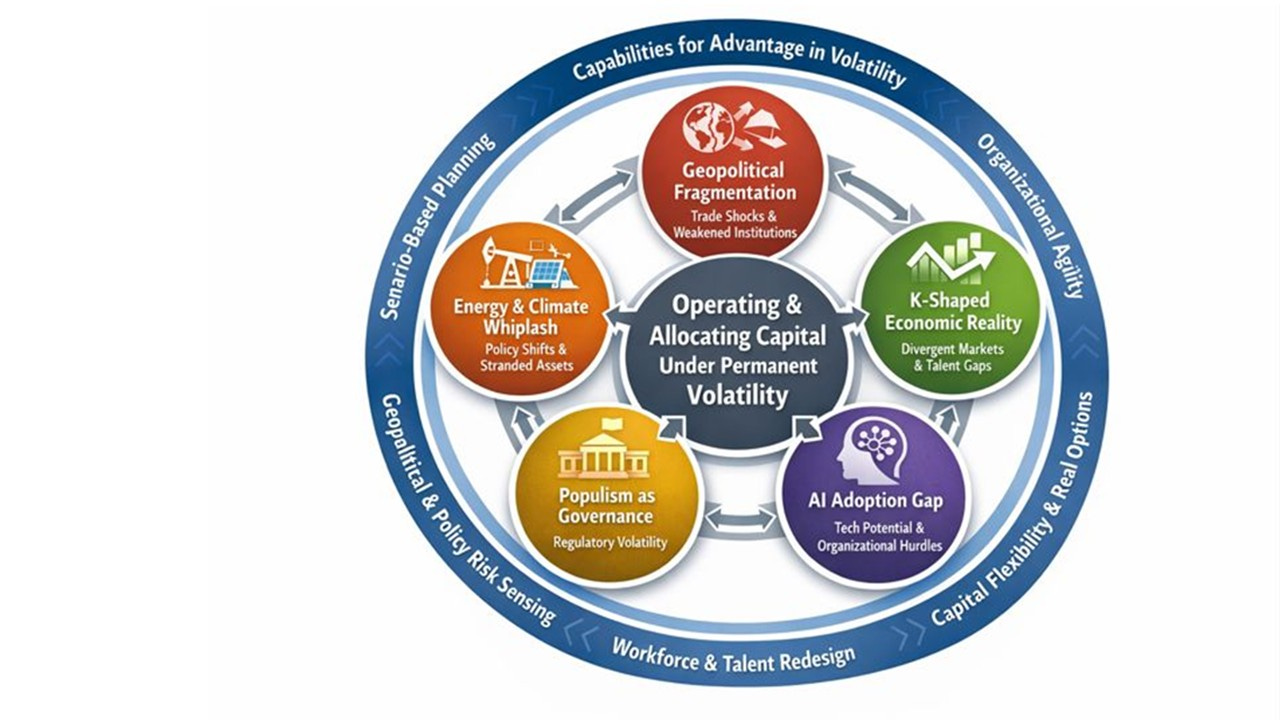
Against that backdrop, we turn to our perspective on the five most important business developments of 2025: why they mattered and what they imply for C-suite leaders looking ahead.
1. Geopolitics and the New World Trade Order
The defining macroeconomic reality of 2025 was not recession or recovery, but fragmentation. As we wrote previously, “with trade increasingly seen as a tool of industrial and foreign policy, global supply chains face massive disruption.” In 2025, that disruption moved decisively from theory to operating reality.
The Trump administration’s sweeping tariffs pushed the U.S. effective import tax rate to levels not seen since the 1930s. Tariffs became less about trade balances and more about leverage, forcing companies to reassess not only where they source and manufacture, but which markets they can reliably serve at all.
A direct confrontation with China exposed a structural asymmetry at the heart of the global economy. Washington’s tariff threats - ranging from 25% to well above 100% on selected imports - were met not with capitulation but with targeted retaliation. Beijing’s response, including export controls on critical rare-earth materials and abrupt halts to U.S. agricultural purchases, underscored that geopolitical leverage increasingly rests on control of bottlenecks, not just trade volumes.
Crucially, the fallout did not remain bilateral. As we warned earlier, “if a tariff spiral does ensue, the indirect spillover effects would likely be significant as well.” Reduced Chinese access to the U.S. market flooded the EU and parts of Latin America with excess capacity, triggering defensive measures across industries such as steel, chemicals, EV components, and industrial machinery. The result was an acceleration toward a more transactional, regionalized trade system.
Geopolitical instability compounded these pressures. Iran’s sharply weakened position, following Israeli military actions and the collapse of much of its proxy network, reshaped Middle Eastern power dynamics. As we noted previously, this raised the risk of broader regional escalation involving the U.S. and other Western powers. For global businesses, the impact was immediate: renewed energy market volatility, higher insurance and logistics costs, and persistent uncertainty around shipping routes and regional investments.
At the same time, the multilateral institutions required for managing systemic risk appeared increasingly fragile. “NATO and the EU, weakened by recent elections, lack cohesion,” limiting Europe’s ability to act as a stabilizing force in security or economic policy. For multinational firms, this meant navigating a patchwork of national responses rather than a coordinated transatlantic approach, particularly in industrial subsidies, defense spending, and trade enforcement. Europe increasingly combined regulatory weight with diminishing growth momentum, an uncomfortable mix for global firms.
Importantly, strain was not confined to emerging markets. “Even North America feels the strain,” as hardline trade and immigration policies amplified uncertainty across U.S.–Mexico–Canada supply chains and intensified labor shortages in logistics, agriculture, and manufacturing.
For the C-suite, the lesson was clear: assumptions of a stable, rules-based global trade system no longer hold. Competitive advantage now depends less on global optimization and more on geopolitical resilience – i.e., supply-chain redundancy, regional manufacturing strategies, and the ability to pivot quickly as trade and foreign policy collide.
2. Economic Resilience Masks a Deepening K-Shaped Recovery
Despite trade turbulence and geopolitical shocks, the U.S. economy proved remarkably resilient. Beneath the surface, however, a K-shaped recovery deepened. Higher-income households continued to spend, while lower-income households faced persistent cost-of-living pressures. In the short term, this divergence sustained aggregate demand. Over the long term, it raises more troubling social and economic questions.
The labor market tells the story. Headline employment remained stable, but hiring slowed markedly, creating a “low-hire, low-fire” environment. Job prospects deteriorated sharply for new college graduates as firms delayed expansion and AI reduced demand for entry-level roles.
At the other end of the spectrum, labor shortages intensified in manufacturing, construction, healthcare, logistics, and agriculture. These shortages were not cyclical but structural, driven by reduced immigration flows, large-scale deportations, and underinvestment in vocational training and reskilling programs.
More concerning still was the erosion of the U.S. as a global talent magnet. Visa crackdowns, higher fees, longer processing times, and a more hostile political climate made the U.S. less attractive to STEM professionals and researchers. For decades, innovation leadership rested on this advantage. In 2025, it began to weaken visibly as top candidates increasingly chose Europe, Canada, or parts of Asia.
For business leaders, the implication is clear: workforce strategy is no longer an HR concern. It is a core element of competitive positioning, productivity, and long-term innovation capacity.
3. AI’s Breakout Year—and Why Value Remained Elusive
2025 was AI’s breakout year. Adoption accelerated, investment surged, and AI moved from experimentation to deployment. Yet for most companies, results fell well short of expectations as multiple studies suggested that as many as 90–95% of corporate AI initiatives failed to deliver meaningful business impact.
History offers a parallel. During the dot-com boom, digital technologies diffused rapidly, but productivity gains lagged for years – i.e., the Solow Paradox. The lesson was not technological but organizational. As we have written previously, organizational change and public policy ultimately shaped the trajectory of past technological revolutions far more than the technologies themselves.
Most AI failures share a common root cause: attempts to layer AI onto legacy structures, processes, and incentives. AI teams often operate in isolation, disconnected from business units, lacking decision rights, clean data, or sustained executive sponsorship.
Public policy adds another layer of complexity. Governments oscillate between promoting AI as a growth engine and constraining it due to concerns over privacy, bias, labor displacement, and national security. As we have noted before, “the future of digital transformation depends on what happens inside organizations and in the external policy environment, not just on the technology itself.”
The implication for executives is clear: AI advantage will accrue not to the early adopters, but to firms willing to redesign how work gets done.
4. The EV Reversal, Energy Policy Whiplash, and the China Question
After years of regulatory momentum, 2025 marked a clear inflection point in the U.S. energy transition. Rollbacks of EV subsidies and renewed support for fossil fuels reshaped investment economics almost overnight. Automakers, utilities, and suppliers were forced to reassess demand trajectories, infrastructure plans, and capital allocation.
The slowdown in EV adoption also reflected a familiar adoption “chasm.” Early adopters were largely saturated, while the early majority remained hesitant due to cost, infrastructure gaps, and resale concerns. This domestic hesitation intersects with a more strategic issue: the rise of Chinese EV manufacturers. As we argued earlier, the threat hinges on two variables: U.S. EV adoption and Chinese market access. In 2025, both became clearer. Firms like BYD demonstrated that they are not theoretical competitors but proven global players, combining vertical integration with aggressive cost advantages.
Mexico emerged as a strategic wildcard. By leveraging USMCA provisions, Chinese OEMs positioned themselves to serve price-sensitive segments, initially with ICE and hybrid vehicles, and potentially EVs later. The risk for U.S. incumbents is not immediate collapse, but strategic drift, leaving them underprepared if adoption reaccelerates and market access widens simultaneously.
The broader lesson extends beyond autos. Energy transitions are no longer linear or globally synchronized. They are politicized, uneven, and competitively disruptive.
5. Populism, Governance, and the Limits of the Old Order
2025 confirmed that populism is no longer a reaction - it has become a governing force. As populist movements transitioned from opposition to administration, internal contradictions became visible. Governing requires compromise, prioritization, and administrative capacity - qualities often at odds with populism’s mobilizing logic.
Across advanced economies, these tensions surfaced repeatedly. Coalitions forged in opposition proved difficult to sustain once policy choices imposed real costs. Protectionism collided with inflation control; immigration crackdowns worsened labor shortages; fiscal populism ran into debt constraints. For businesses, this represents a structural increase in political risk across markets once considered stable. The challenge is no longer how to wait out populism, but how to operate in an environment of fragmented legitimacy and uneven governance capacity.
Strategic Takeaways for C-Suite Executives
If 2025 demonstrated anything, it is that volatility is no longer an aberration - it is the new baseline.
First, enterprise risk must be mapped globally and dynamically. JIT supply chains optimized for efficiency have become structurally fragile.
Second, executives must plan for divergent consumer segments and labor realities shaped by uneven adoption, constrained talent supply, and shifting migration patterns.
Third, technology creates value only when paired with organizational change and governance. Tools alone are insufficient.
Fourth, energy and climate policy uncertainty must be incorporated into capital planning. Linear transition assumptions are no longer viable.
Finally, populism has moved from protest to power without fully replacing the old order, creating regulatory fragmentation that demands rigorous stress-testing.
If 2025 was the year companies absorbed this reality, 2026 will be about translating reactive resilience into proactive foresight and strategy. Ultimately, the organizations that succeed will stop waiting for clarity and instead build the organizational capabilities and processes needed to perform consistently across volatility and uncertainty.
References
Are Chinese EV Makers an Existential Threat to U.S. Legacy Automakers?, Jul ‘25
The Rare-Earth Chokehold, Jun ‘25
Seeing Around Corners, Mar ‘25
2024 Questions Revisited - Looking Back and Looking Ahead, Jan ‘25
Preparing for Trade Disruptions, Dec ‘24
Prestige vs. Dominance: Leadership Matters in the U.S. Presidential Election, Nov ‘24
The Electric Vehicle Slowdown: A Lesson in Technology Diffusion and Saddle Patterns, Aug ‘24
Strategic Planning for U.S. Election Scenarios, Jul ‘24
2024 – The Year Questions Become Answers, Feb ‘24
Turbulence Ahead: US-China Relations in a Shifting Landscape, Sep ‘23
Scenarios for the Future of AI and Digital Transformation, Jun ‘23
Learning from the History of Technological Revolutions, May ‘23