

Prediction markets have exploded in popularity in the last year, with $86B having been traded in 2024 on the two largest platforms, Kalshi and Polymarket. These markets offer event contracts with binary payoffs attached to the occurrence or non-occurrence of that event. Most of the money wagered is on sports, but prediction markets have untapped potential for business value in forecasting, decision-making, and – especially – risk and crisis management. The business value comes not from betting on outcomes, but from the information prediction markets provide on event probabilities.
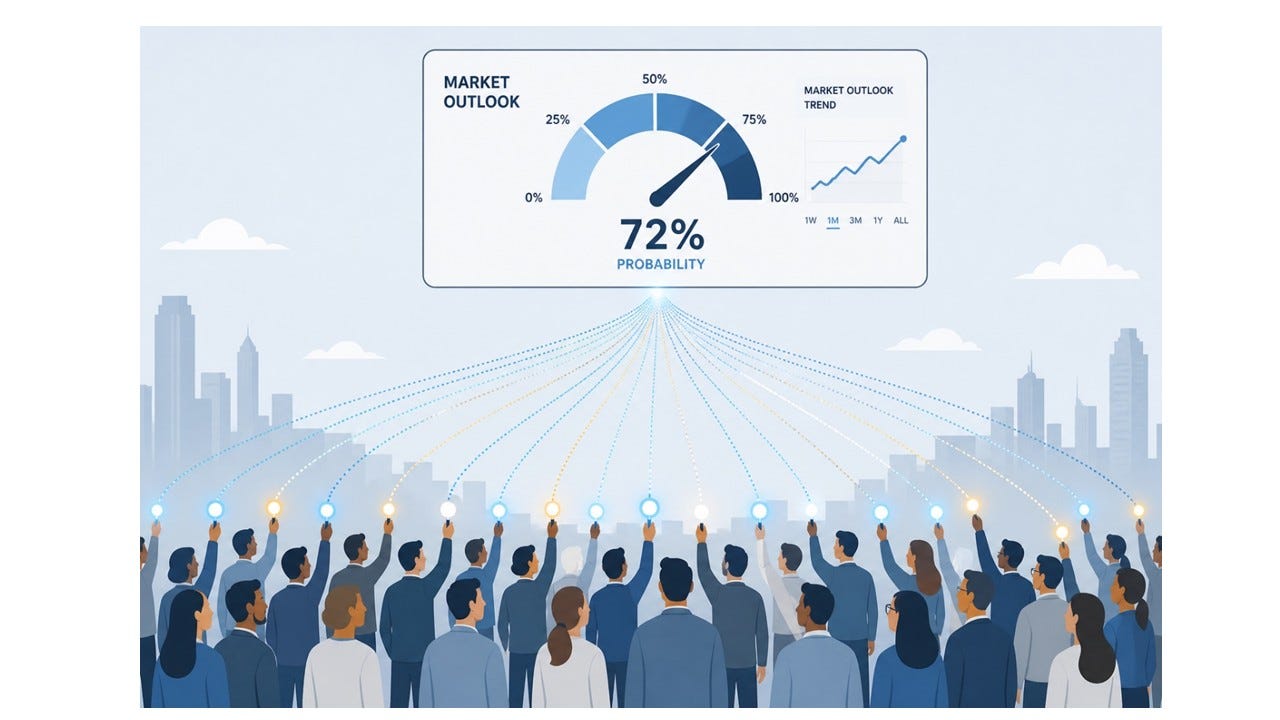
Prediction markets aggregate information
Prediction markets, like the stock market, aggregate expert knowledge and public and semi-public information. If the probability of an event is different than what is reflected in the price, people will bet to make a profit. Their bets will move the prediction market price toward the “correct” value. If the probability changes due to new information, the prediction market price will quickly adjust. If the market is mature and the number of contracts is large, experts have a financial incentive to participate and the market price should be an accurate real-time estimate of the probability of the event. This estimate –and its responsiveness to information – is the key source of business value.
Using prediction markets for crisis preparation and management
To understand the potential of prediction markets for crisis preparation and management, consider current geopolitical uncertainty. For example, many business decisions depend on North American trade and tariffs. Board and CEOs will want assurance that the company will be able to manage all the ramifications of USMCA scenarios, up to and including a full US exit. For many companies, however, going beyond a high-level analysis would be difficult and time-consuming and implementing full mitigation would be quite costly. The leadership could set “DefCon” levels [similar to the U.S. military’s readiness alert system], with higher risk triggering more aggressive and painful mitigation efforts. If the prediction markets are active, the probability of particular USMCA outcomes would be an excellent objective real-time signal for triggering the appropriate response.
This is not an isolated case. Whenever a change in the probability of an event would trigger a decision or action, a corresponding prediction market would be valuable information. This is true both of events that occur – Trump’s election or Russia’s invasion of Ukraine – and fears that do not materialize, like the collapse of the Euro in 2012 or a Korea crisis in 2018.
Probabilities from prediction markets could also improve scenario analysis and wargaming. If a consequential event has high enough probability of occurring (say at least 10%) that would be the signal to do a scenario analysis of the event, with the probability also helping mitigation decisions.
Improving forecasts with prediction markets
Decisions on product programs, capacity investments, hiring, and business plans all rely on forecasts of industry volume, market share, pricing, and costs. Too often these forecasts have an optimistic bias, reflecting pressure on the forecasters and leaders to meet targets and get funding approved. There is also a bias towards smooth growth, discounting disruptive events or technologies. Five-year plans often look like hockey sticks, with conservative estimates for the budget year (so that bonus targets are reached) and bright optimism beyond. The next year the hockey stick has moved out a year.
Public prediction markets might help correct some of the bias, particularly as the number of contracts and market participants increases. A market forecast of U.S. vehicle or full-size truck sales in 2027 or 2030 could help automakers and suppliers plan. Probabilities of election outcomes or high oil prices or a Taiwan invasion could help select and calibrate stress-test scenarios. One challenge to such applications is that the event contract might not exist for many risks relevant to the company, particularly for the longer horizon of investment decisions. Companies should experiment with establishing event contracts tied to information they need in decision-making.
Internal prediction markets
Public markets could be supplemented with internal “markets”. Employees could place bets, for example, on whether or not a particular market share would be achieved. While such markets could potentially overcome bias, there would be challenges to making it work. Companies would need to worry about insider trading or market manipulation or distorting individual incentives for company success. The best use-case might be an external event where there is diffuse insight within the company. For example, “will the new product launch of a leading competitor increase its market share by more than 1 point next year.” Companies might want to pilot an internal market with a group of internal experts.
Concerns with prediction markets
The growth of prediction markets has raised understandable and appropriate concerns about rules, regulatory arbitrage, insider trading, and market manipulation. The indictment of a U.S. soldier for allegedly profiting from insider information on the Venezuela operation is only one instance. But for a business using prediction markets for information rather than to make bets, insider trading is not a concern. Kalshi is currently regulated by the CFTC though the rules are in flux, while Polymarket is currently outside U.S. jurisdiction. Congress and states are trying to establish rules and guardrails. The inevitable increase in oversight and regulation of these markets will be good news for the same reason it is in the stock market; it will increase trust and transparency, encouraging wide participation.
The Bottom Line
Using the power of markets to find the probabilities of events is an important advance. Businesses should try to develop markets in event probabilities that could affect decisions. As prediction markets mature, they should monitor developments with the goal of leveraging this innovative information source.
Thank you for trying to make sense of so much nonsense in this world, and for your continuing good sense!