

One of the world’s most influential economists on the fracturing trade order, the future of the international financial system, what AI means for rich and poor countries, and what business leaders are getting wrong.
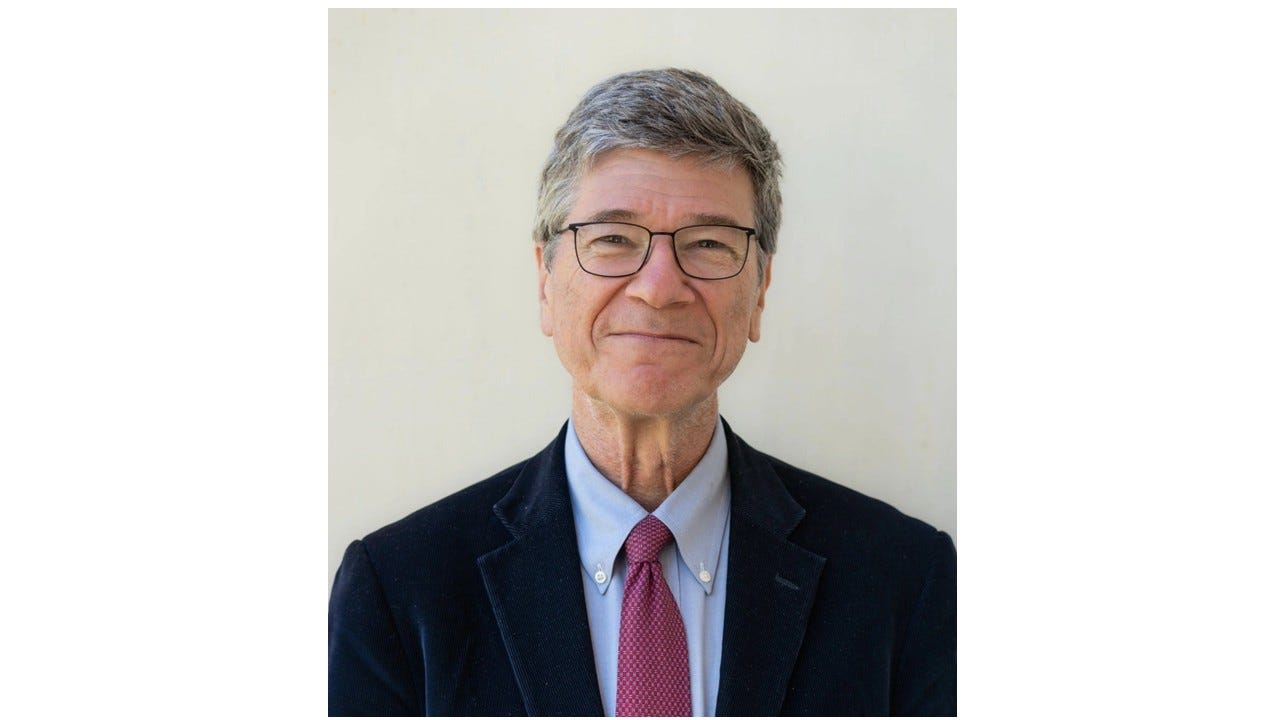
Jeffrey D. Sachs is a world-renowned economics professor, bestselling author, innovative educator, and global leader in sustainable development. He is University Professor at Columbia University and Director of its Center for Sustainable Development. He is President of the UN Sustainable Development Solutions Network and has advised governments, heads of state, and international institutions on economic development for four decades. His books include The End of Poverty, The Price of Civilization, and The Age of Sustainable Development.
C-Suite: The postwar trading system is fracturing – tariffs, industrial policy, export controls – on a scale we haven’t seen in decades. What is driving this, and what should business leaders understand about it that most don’t?
The postwar trading system was a genuine success story. It produced decades of growth, enabled poorer regions to develop, diffused technology globally, and did exactly what Adam Smith described in 1776: a larger market allows for specialization and mutual benefit. The problem is that this history gets badly misread the moment you adopt a zero-sum mindset, where any gain by China is automatically a loss for America. On that logic, China’s development becomes a threat rather than a shared achievement and letting China into the WTO becomes the greatest mistake America ever made. I think that is a fundamental misunderstanding, and it is driving policy off a cliff.
There are two specific conceptual mistakes at the core of current U.S. trade policy. The first is that China took our jobs and we’re going to get them back. I was recently in a solar module plant outside Shanghai – several football fields in size, one of the top producers of panels in the world – and there were perhaps twenty people in the entire facility. Every machine was robotic and AI-driven. You cannot bring jobs back that no longer exist. Manufacturing employment in the U.S. actually fell by 100,000 jobs between January 2025 and January 2026. That trend will continue, because manufacturing is becoming overwhelmingly a robotics and AI-driven process across virtually every industry.
The second mistake is the belief that trade deficits reflect unfairness by China or others. This is something I address on the first day of my international monetary economics class. A trade deficit reflects the fact that you are spending more than you are producing, for whatever reason. In the American case, we have a giant national credit card called the federal government, which borrows roughly 7% of GDP right now. We spend a lot of money that we borrow from abroad. This has been going on for forty years, since Ronald Reagan initiated two generations of tax cutting. We’re now hemorrhaging public debt, and the trade deficit is a consequence of that, not of Chinese unfairness.
The trading system worked. We are now in the process of destroying it. What I hear from the people driving U.S. trade policy – the Lutnicks and Navarros of this world – would not pass for a first-year student in a first-year trade class. None of it holds any water.
C-Suite: How should boards be thinking about political risk in the context of U.S.-China relations becoming increasingly contentious and with some people invoking a Thucydides Trap (the idea that a rising power and an established one tend toward conflict)?
The clearest explanation of the U.S.-China situation that I know is a paper written in March 2015 by Robert Blackwill and Ashley Tellis for the Council on Foreign Relations, titled “A Grand Strategy for the United States Toward China.” I don’t agree with any of it, but it is admirably clear, and I think it is an explication of actual American statecraft rather than just a thought piece.
The paper’s logic is explicit: America’s grand strategy is primacy and China’s rise is a threat to primacy. Therefore, China’s continued rise is no longer in America’s interest. It then lists what to do, and the list is exactly what has been done; export restrictions on technology, trade blocs that exclude China, military build-up along China’s rimlands, and so forth. Nine or ten headline strategies, all of which have been pursued in the last decade. To my mind, none of them works. None actually contains China or advances American interests. But they do break apart the trading system and create significant problems for the United States going forward.
The two economies were deeply interpenetrated until recently. We have supply chains that depend on China, and we have markets in China, and they are being broken apart.
C-Suite: You described a solar module plant outside Shanghai. Green technology more broadly, where does that fit into the competitive picture for business leaders?
Climate change is not a hoax. It is something very serious, and it is getting worse at a dramatic and accelerating rate. Whoever dominates green technology in the future is going to, at a business level, make a lot of money, and at a national level, make a successful economy.
The United States has largely abandoned that sphere. China, I think, will be at the center of green technology for the next twenty to twenty-five years, given where things stand right now. This is very regrettable, and it is also a massive strategic mistake. On electric vehicles specifically, unless I am misreading something, we are absolutely surrendering that industry to China. Trump is not merely aggravating this. He may be putting a stake through the heart of the American automotive sector outside the protected domestic market. And we know that kind of protected market doesn’t last long.
For a C-suite executive, the first question should always be: what is the real future market or trend that is relevant to my business? And the answer, for almost anyone with exposure to energy, manufacturing, or transportation, is that green technology is one of the defining competitive battlegrounds of the next two decades. Simply denying this reality is deeply counterproductive.
C-Suite: You have been a long-standing critic of the IMF and the World Bank, and of the U.S. role in the international financial system. What do you see as the future of that system and what should CFOs be doing about it now?
Let me explain my critique from the ground up. At a core level, financial markets are crucial for a functioning economy, but they are intrinsically unstable. They rely overwhelmingly on expectations, which are subject to all sorts of influences and self-fulfilling prophecies. History is pockmarked by panics, manias, and crazes. This is well understood in financial history and has occasionally been rewarded with Nobel Prizes.
The two greatest accomplishments in modern monetary policy came in 1933 and 1934, in the depths of the Depression: the Federal Reserve finally understood that it was the lender of last resort to the banking system, and the introduction of federal deposit insurance. Those two changes put an end to the kind of commercial banking failures that had plagued the U.S. roughly every twenty years: 1873, 1893, 1907, 1933. What looked like an intrinsic feature of capitalism turned out to be a defect that could be corrected by clear and relatively straightforward policies.
When that lender-of-last-resort function fails, or is withheld, the consequences are catastrophic, as 2008 showed. The disaster of September 15th occurred because the Treasury Secretary forced Lehman Brothers into bankruptcy, almost to prove a point to Wall Street. He could have arranged a Barclays acquisition and avoided a multi-trillion dollar calamity. Instead, we had a collapse that put the world economy into a tailspin for several years. That was a pure policy mistake, and it is exactly the kind of mistake that a properly functioning international lender of last resort is supposed to prevent.
C-Suite: And where does the U.S. role in all this come in?
My critique of the current system is that the United States is misusing the dollar by weaponizing it. Twenty years ago, the U.S. began confiscating countries’ reserves, blocking countries from using SWIFT, and deploying other such measures as instruments of foreign policy. I believe these two things must be kept completely separate. Foreign policy is one thing; monetary policy is another. When foreign policy people meddle in the financial system, they destroy it and they are destroying the role of the dollar very quickly right now.
My critique of the IMF is that it is not the international lender of last resort that it should be. If financial markets are intrinsically unstable, you need a lender of last resort, just as the Fed is within the domestic system. Instead, the IMF functions more like a mortician. The country arrives dead after the crisis has already occurred, the debt is already in suspension, and the IMF dresses up the corpse. It takes three or four years for the zombie to come back to life. The IMF does not act proactively; it is not permitted to. It does not lend freely and quickly in a crisis mode to prevent the panic. It works on the debt workout once an insolvency event has happened.
The World Bank’s situation is different. My critique there is simply that it is too small. It lends $50 to $100 billion a year in a world economy of over $100 trillion. It has a prestigious address and a big name, but it is a tiny player. One reason it remains small is that if it were larger, China would get a bigger vote, and the United States prefers that it stay small with China’s influence limited.
C-Suite: Do you see any of that changing in the near future?
Probably not, because the geopolitical issue is not being wisely handled. What the United States should be doing is making the world safe for multipolarity. I started saying this about thirty years ago: we would have a multipolar world, and a far-sighted United States would help shape that world in ways that serve our long-term interests. Instead, we have pursued a strategy of preserving primacy, which puts us into conflict with the other major powers, Russia and China. That, I think, is the root of most of the problems we face right now.
I had some hope that Trump rather understood this was a multipolar world. Marco Rubio even said as much in one of his first statements as Secretary of State. But Trump said a couple of days ago that America’s goal is to remain the undisputed powerhouse of the world. That turned out to be the real policy. And that is very hard to sustain when you are 4% of the world’s population, a lot of clever people are everywhere else, and none of them are particularly interested in following American demands. The goal America has set for itself is unachievable, and the mere act of pursuing it is therefore extremely dangerous, because it is delusional.
C-Suite: On the dollar specifically, how significant is the de-dollarization risk on a five-to-ten-year horizon, and what does that mean for a CFO or treasurer?
Right now, the dollar is the currency of invoicing and settlement for roughly 60% of international transactions; the renminbi is around 5%. Ten years from now, I would expect the renminbi to be the currency of settlement for at least 20% of international transactions, and the dollar to be below 50%. We will definitely be in at least a two-currency system. You could imagine it being more. The Euro could become a more significant international currency if Europe and the U.S. have more separation, which seems increasingly likely given the current trajectory.
Twenty years from now, there will probably be an African currency covering most of the continent, a convertible rupee, a convertible renminbi, and the dollar will not dominate by any means. It may account for 30% of international trade, but it will not stand out as the world’s currency. We will not necessarily go the way of the pound sterling; it took two world wars and the end of the British Empire to break sterling, and God forbid anything remotely like that happens.
For a treasurer today, bank accounts denominated in renminbi, probably in rupees, and even in rubles, are all going to play a much bigger role in the future. That is something to be building into your financial planning now, not in ten years.
C-Suite: Given everything we’ve discussed about technology and economic development, what is your overall assessment of the potential impact of AI?
I am, in general, a technophile, and I am a believer that AI is very real, extraordinarily powerful, and not hyped. I would not have believed, ten years ago, that you could train a trillion-parameter model and have it available for a substantive intellectual discussion. As a daily and hourly user of AI for the work I do, I can say I am quite impressed. It reads journals faster than I do, it summarizes things extremely well, and for someone who works with data and information intensively, it is a huge advance.
In Chinese factories today, AI is already deeply embedded at every stage of production. In one plant I visited outside Shanghai, every machine had an AI role: testing whether wiring had been placed correctly, whether leads were properly set, whether electrolytes were balanced – all without a person anywhere in sight. This is manufacturing in China right now.
C-Suite: How does that translate to the labor market?
I also think AI will have profound and difficult effects on the labor market. Over the last two hundred years, technology has basically eliminated more jobs than it has created, and on the whole, that has been good. Our economy, at nearly $90,000 per capita, operates with adults putting in an average of three hours and fifteen minutes of work per day, according to U.S. government time-use surveys. What used to be twelve-to-fourteen-hour days of physical labor has been replaced, not by other jobs, but by leisure, study, retirement, and weekends. If you simply allow AI to do its job without any policy response, however, you will produce an underclass that is profoundly large. The approach, in one way or another, has to be to socialize a significant portion of consumption – through education, healthcare, public services – so that people’s living standards are not tied entirely to their individual position in the labor market. The United States does this much worse than Europe, and we have no coherent plan for what AI is going to do next, which will be a faster and larger effect than robotics was on the assembly line over the last thirty years.
C-Suite: What about for developing countries? Do you think AI will narrow or widen the gaps?
On the whole, I think it will narrow the gaps, though it does one thing that dramatically changes the development picture: it eliminates the labor-intensive manufacturing pathway that drove the great successes of Asia over the last fifty years. China, and the Asian Tigers before, all moved up the technology ladder from assembling electronics and cutting apparel to more advanced manufacturing. That pathway is gone. There are no jobs left in labor-intensive manufacturing; they are being automated and quickly.
But the advantages of AI for development on the other side are enormous. Education can be completely revolutionized. Healthcare can be completely revolutionized. Payment systems, credit systems, farm management, public service delivery: everything can be transformed, and I am seeing this happen in very poor settings. In India, you can go to the most remote rural village and every vegetable vendor has a QR code for online payment. I am involved in projects putting AI into the hands of high-school-educated health workers and nutrition support workers in villages, and it works extremely well.
The fundamental redesign of development strategy is now at hand. An African country is no longer going to sell unskilled labor. It is going to sell strategic minerals, downstream battery supply chains, commodity-based industrialization in metallurgy or specialty steels, agro-industry, tourism, the creative economy, online services. But it is going to have to be skilled. And that creates a very different set of priorities. I am working on exactly this with a number of governments and with the African Union right now. On the whole, this is a huge plus, because suddenly you have a very information-rich environment in a low-income setting, which was not the case before.
C-Suite: The U.S. has essentially dismantled its development aid programs. What is the realistic trajectory for Sub-Saharan Africa and other developing regions, and what role, if any, does aid play going forward?
I spent the first twenty or twenty-five years of my career promoting these programs, and I am proud of some of it. I believe I was the progenitor of the Global Fund to Fight AIDS, TB, and Malaria, and that has saved millions of lives and proved the point I made at the time; that there are low-cost interventions that could have a huge benefit and that were simply not getting done otherwise. It worked.
I always thought a little generosity could go a long way, and I liked the idea that the rich world should give 1% of its income to the poor. It turned out to be impossible. The United States came closest to that target in the Marshall Plan era, approaching 1% of GDP, before falling to around half a percent through the 1950s and declining from there. Aid collapsed further when the Soviet Union ended, because a lot of it had been motivated by competing for hearts and minds with the Soviet threat. We reached about 0.1% of GDP, and now we have eliminated development aid altogether.
Since I do not like pounding my head against a wall, I have largely stopped dealing with aid as such over the last ten years – not because it was wrong, but because it was a losing approach. I was not making headway. So now I spend most of my time trying to make the financial system work better for poor countries. Most of what is needed in development can be done through market finance, just not five-year euro bonds. Development is a twenty-five-year process, not a five-year process. If you borrow at five-year maturity for a twenty-five-year investment and you are a developing country, you are going to get into a debt crisis before your investment pays off. The case for maturity matching in development finance is fundamental and has never been seriously addressed.
As for aid today, it is not even a topic of polite conversation in Washington. It is simply not on the table. The task now is to build development finance mechanisms that do not depend on political generosity that never reliably materializes.
C-Suite: If you had to name one thing that most C-suite leaders are systematically getting wrong about the world right now, what would it be?
I want to be fair to business leaders here. In general, they are smart, practical people trying to make their businesses work. Where I see the real delusions are in Washington, not in the boardroom. Business leaders are trying to figure out what to do in a world they did not make and cannot fully control.
But what they should know is this: there is a big world out there, and it is a very sophisticated world. There are places with excellent technology and highly capable people everywhere you look, including places that American foreign policy has caricatured. The world doesn’t go away because we say so. It does not follow U.S. demands simply because we demand it.
The United States should continue to try to be a competitive, active, outward-looking, and optimistic part of the world. That is our best hope and our heritage. The great American strength has been our capacity to draw talent from all over the world, and to understand that science and technology are at the base of our long-term strength. Both of those are currently under self-attack; through the treatment of our universities, through the signals we are sending to foreign students and researchers who are now genuinely afraid to cross the U.S. border.
I can tell you that all of my foreign students are afraid right now. Every one of them, when they cross the border, does not know whether they will be coming back, whether they will be pulled aside for questioning at the airport, whether their phones will be confiscated, whether their social media will be read. A lot of students who would normally have come to the United States are now looking to study elsewhere. These are not mistakes of C-suite executives. But they are things that C-suite executives should know, and should factor into how they think about talent, innovation, and the long-term vitality of the American economy.
We do best when we are optimistic, outward-looking participants in a big, diverse world. We do worse when we view that world with fear and try to close up. That is not merely a political observation, it is an economic one.
Yep, Trump has screwed everything, that was in the works, up. Thank you for this erudite interview, and keep up the good work!