

While virtually the entire Beltway punditocracy predicted the blue wave Democrats had hoped for in the midterms, almost no one foresaw the electoral tsunami that washed over both chambers of Congress earlier this month. Democrats won a clear majority in the House and retook the Senate, flipping an astonishing nine Republican seats, including in Texas and Kansas, which had not elected a Democratic senator since 1988 and 1932, respectively.
What happens now? Early indications suggest that both parties have concluded that conflict is more attractive than compromise, which all but guarantees a return to gridlock when the new Congress convenes in January. Senate Democratic leader Chuck Schumer declared on election night that “relief is on the way,” while Robert Garcia, the presumptive chair of the House Oversight Committee, warned Trump administration officials to “lawyer up.” The White House responded within days with a sharply worded letter. Not to be outdone, President Trump has promised to veto any Democratic bill that comes his way. He also replaced Susie Wiles as White House chief of staff with Stephen Miller, a combative loyalist and the architect of his hard-line immigration policies.
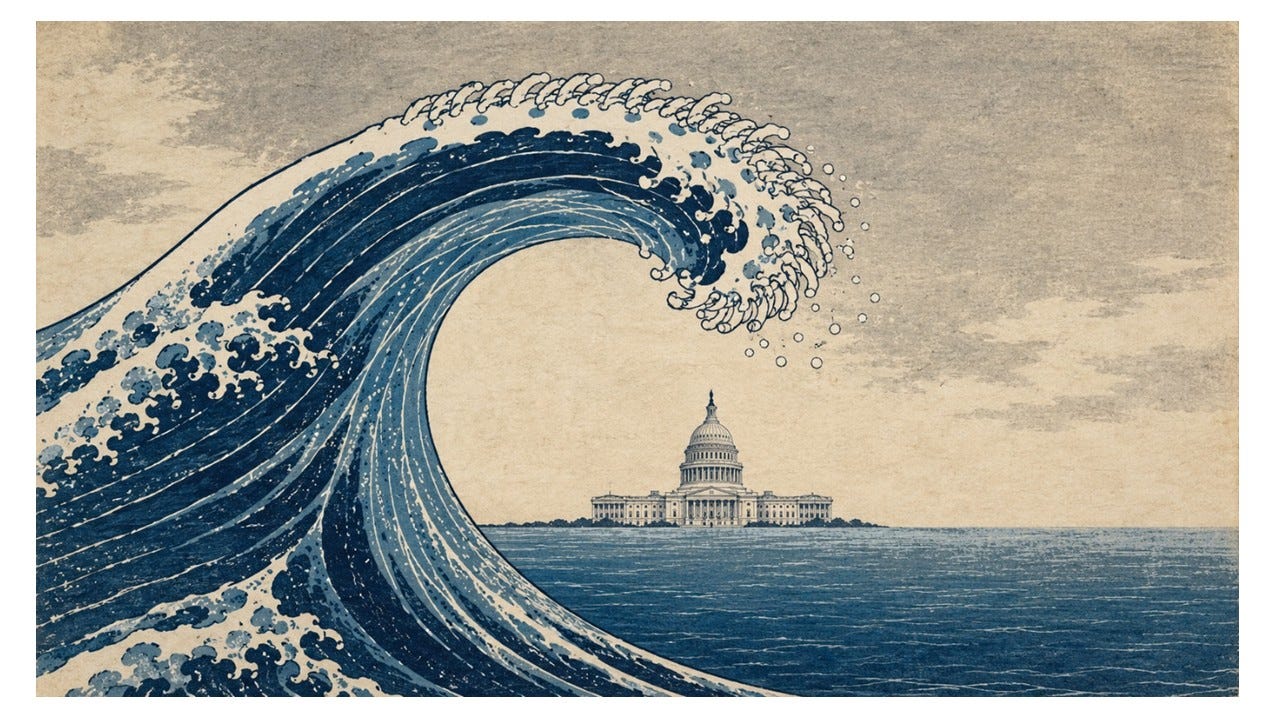
Gridlock with a Vengeance
C-Suite executives may be tempted to breathe a sigh of relief, reasoning that gridlock could actually be good for business. After all, if Washington can’t pass any major legislation, at least it can’t do much harm either. That would be a mistake, however, because this time gridlock is unlikely to be benign. A Democratic Congress can block legislation, but the executive branch, indeed President Trump himself, will retain a largely free hand in trade and foreign policy, and with his domestic agenda stalled, he will be all the more tempted to use it. In other words, a weakened president with broad unilateral powers is more likely to be a source of volatility than of stability.
At the same time, the U.S. economy has little room to cushion the blow. In September, the Fed raised rates for the first time in three years while Brent crude climbed back above $100 a barrel. In October, the yield on the ten-year Treasury reached 5.36%, its highest level in 24 years. Shocks that a healthier economy could absorb relatively easily will now hit companies that are already paying materially more for both energy and capital. Several deadlines are also close. Government funding expires on December 11th, the threatened 50% tariff on Canadian autos is due to take effect on January 1st, and a new Congress convenes shortly after.
So, C-Suite executives should prepare for four risks that could all materialize within the next 90 days or so:
1) Trade War Escalation
2) Extended Government Shutdown
3) Broad Data Center Moratoria
4) Geopolitical Escalation
None of these risks is certain, but all are plausible enough to plan for.
North by Northwest
Risk 1 (Trade War Escalation). Likelihood: high. Impact: high.
The most immediate threat comes from a renewed trade war with Canada. After talks with Ottawa collapsed in August, reportedly in part over the treatment of medium and heavy trucks, President Trump announced that tariffs on “all” Canadian cars, trucks and auto parts would rise to 50% on January 1st. Today, Canadian vehicles that qualify under USMCA pay 25%, and only on their non-US content; Canadian steel already faces a 50% duty.
No formal order has been published as of this writing, so much remains unclear, including whether vehicles and parts that qualify under USMCA will keep their preferential treatment. There is reason for concern, however. The separate 50% tariff that Washington has imposed on a range of other Canadian goods since August falls under Section 338 of the 1930 Smoot-Hawley Tariff Act, the law long blamed for deepening the Great Depression, and it makes no allowance for USMCA-qualifying goods. The January increase may well follow the same template.
A trade deal remains possible. Both President Trump and Prime Minister Mark Carney have said as much, and Mr. Carney has made clear that Canada’s priority is preserving a viable auto industry. Some auto executives are counting on exactly that, pointing to earlier tariff threats that were delayed or scaled back. Yet it would be a mistake to bet on it. With a Democratic Congress blocking his domestic agenda, trade is one of the few arenas where President Trump can still act on his own, and it may well become even more central to how he views his legacy.
Nor are the usual checks and balances likely to restrain him. Over the decades, Congress has handed the president broad trade powers, most notably through Section 232 of the Trade Expansion Act of 1962 and Section 301 of the Trade Act of 1974. Most Democrats oppose the administration’s trade war, especially with close allies like Canada, but without the two-thirds majority needed to override a veto, the new majority will have little ability to rein in the president. The courts offer limited protection as well. After the Supreme Court struck down the emergency tariffs in a 6-3 ruling earlier this year, the administration simply rebuilt its tariff wall on Sections 232 and 301, which rest on explicit authority from Congress and have generally held up in court. As a result, tariffs could return to last year’s levels, or go even higher, with little chance that the courts will intervene.
Then again, the legacy argument cuts both ways. A second-term president, weakened at home and eager to cement his place in history, might also accept terms he would otherwise have rejected, simply to claim a win. Either way, the cost of being unprepared on January 1st is far higher than the cost of preparing for a tariff hike that never arrives.
Groundhog Day
Risk 2 (Extended Government Shutdown). Likelihood: high. Impact: medium.
Shutdowns have regrettably become routine in American politics. Last year’s 43-day shutdown set an unenviable record, and there were two more major funding lapses this year; by Speaker Mike Johnson’s count, roughly a third of the year went without full funding. That record could easily fall over the next two years. The December 11th deadline is unlikely to cause much trouble, as Republicans remain in full control during the lame-duck session and will most likely pass another stopgap bill. The real test will come in January, when Democrats take over and begin negotiating with the White House.
An emboldened Democratic Congress will come with demands of its own, above all restoring funding for health care subsidies and curbing the administration’s practice of shifting or withholding funds that Congress has already appropriated. The budget is where Congress has the most leverage over the White House, which makes it the likely battleground for next year’s showdown. Despite their frequency, shutdowns remain unpopular with voters on both sides of the political divide, so there is a limit to how far the new majority can afford to push. Yet with the government set to hit the debt limit as soon as February, a new shutdown record is entirely in the cards.
Even short shutdowns leave a mark. The Congressional Budget Office estimated that the 35-day shutdown of 2018–19 cost the economy about $11 billion, roughly $3 billion of which was never recovered, and the outlook today is considerably more fragile than it was then. In the near term, a new shutdown would hurt mostly through reduced government spending. The bigger risk lies in the bond market. Investors already expect the Fed to keep raising rates next year and are increasingly worried about the size of the federal deficit; an open-ended shutdown could weaken demand for Treasuries and push corporate borrowing costs even higher, at precisely the wrong moment.
The Day the Data Stood Still
Risk 3 (Broad Data Center Moratoria). Likelihood: medium. Impact: high.
Media coverage, and the Democrats’ own commentary, have focused primarily on affordability as the driver of this month’s blue tsunami. But the election also delivered a verdict on data centers, one of the few issues that now cuts across both geography and party lines. Voters weighed in on dozens of data center measures on their November ballots, and local governments in 40 states have already enacted some form of ban or moratorium. New York has gone even further, suspending a key category of environmental permits for large data centers statewide.
Because data centers are regulated at the state and local level, governors and state legislators hold real power over them. Governors-elect in Georgia, Michigan, New Mexico, Ohio, and Texas all campaigned on stopping or at least pausing construction statewide, while those in New York and Oregon pledged to extend pauses already in place. According to market intelligence firm Cleanview, about 40% of planned U.S. data center capacity sits in states whose newly elected governors have promised to stop or pause construction.
It remains to be seen how many projects will actually be delayed or canceled altogether. States will continue to compete, and compete fiercely, for new investment, while moratoria typically don’t apply to projects already under construction. Still, the risk of a significant slowdown in AI investment is real. For suppliers of power generation, cooling and construction equipment, AI spending has been one of the few genuine tailwinds in recent years that could quickly turn into a headwind. Yet, there is a silver lining for everyone else, as less AI-driven borrowing would ease pressure on credit markets and could even bring down federal borrowing costs.
Risk 4: Geopolitics - The Great Escape
Risk 4 (Geopolitical Escalation). Likelihood: medium. Impact: very high.
Presidents who lose control of Congress have often turned their attention from domestic matters to foreign affairs, where they face fewer constraints. Ronald Reagan signed the INF Treaty with Mikhail Gorbachev after Democrats retook the Senate in 1986, Bill Clinton secured the Dayton Accords that ended the war in Bosnia after losing both chambers in 1994, and George W. Bush ordered the troop surge in Iraq after losing both in 2006. After Democrats lost the Senate in 2014, Barack Obama opened relations with Cuba and concluded both the Iran nuclear deal and the Paris climate agreement, largely through executive action rather than through Congress. And after losing the House in 2018, President Trump himself met Kim Jong Un in Hanoi, raised tariffs on $200 billion of Chinese goods from 10% to 25%, and threatened tariffs on all Mexican imports.
President Trump still has ambitions to remake America’s relationships with China, Russia, Europe and the rest of the Americas, not to mention his unfinished business in the Middle East.
Iran represents the greatest near-term risk. A June agreement paused the war that began in February but never produced a settlement, and the conflict has since settled into what Iranian officials call “neither war nor peace,” with the Strait of Hormuz still effectively closed. Iran’s allies in Yemen, the Houthis, have raised the temperature considerably. Their blockade of Saudi shipping has all but shut the Red Sea’s southern exit to Saudi oil, forcing tankers bound for Asia north through the Suez Canal on a far longer route, and they have since struck Saudi oil facilities and even Riyadh’s airport. President Trump, meanwhile, has sent mixed signals since the election, saying he would make the same decision to go to war again and that the US remains “locked and loaded,” while calling further strikes “quite unlikely.” Any further escalation would likely have a bigger and longer-lasting impact on energy prices than anything seen so far.
Meanwhile, Europe’s political center of gravity continues to shift to the (far) right. In Germany, the AfD came first in two state elections in September and now leads the national polls by double digits, putting Chancellor Merz’s coalition under considerable strain. His coalition partner, the once-mighty SPD, is polling at a mere 15% and is no longer considered a Volkspartei (literally, a “people’s party”). In France, the far-right National Rally also leads the polls and, even though an appeals court upheld Marine Le Pen’s conviction, it simultaneously cleared the way for her to run for president next April. Even in the Netherlands, where voters swung back to the center last year, the new minority cabinet commands just 66 of 150 seats, and Dutch politics remains as unstable as we predicted three years ago. The upshot is that weaker governments in Berlin, Paris, The Hague and elsewhere will find it much harder to respond to new tariffs, let alone American demands on Ukraine and defense spending.
Finally, Taiwan remains the ultimate tail risk. As we argued in an earlier Quick Take, a Chinese military move is unlikely in the near term. Beijing could nevertheless conclude that the AI economy’s dependence on Taiwanese chips, combined with a distracted and divided West, gives it more leverage to increase pressure on the island. The probability may be low, but the impact on any company whose products contain semiconductors would be severe, as automakers learned during the far smaller chip shortage of 2021.
You Can See Everything
Each of these four risks is significant but probably manageable on its own. Look at them together, though, and a clear pattern emerges. All four run through the same channel, companies’ cost of capital. How? Tariffs and higher oil prices push up import and energy costs, which feed inflation and keep the Fed raising rates. Another shutdown and a debt-limit standoff would make investors demand a higher premium for holding Treasuries at a time when yields are already at multi-decade highs, pushing borrowing costs higher still. Only a reversal in AI investment would push in the other direction, slowing growth but easing pressure on interest rates. The worst case, and an entirely plausible one, is a combination of higher tariffs, an oil price spike and an extended shutdown, which would leave companies facing weaker demand and higher interest rates at the same time.
Risky Business
If they haven’t done so already, C-Suite executives should stress-test their 2027 business plans against exactly that combination of risks. That starts with protecting access to capital, for example by pulling forward scheduled refinancing before borrowing costs climb any further. Companies with direct or indirect exposure to Canadian automotive supply chains shouldn’t wait until January to form a task force either. They should map their exposure by part, supplier, and plant now, and decide in advance how they would respond on inventory, pricing, and sourcing if the 50% tariff does take effect. Finally, executives should understand how much of their demand depends on data center construction, or on federal customers, payments, and approvals that a shutdown would freeze.
Above all, C-Suite executives should continue to think in terms of strategic scenarios rather than best-case, worst-case, and best-guess forecasts. They should develop contingency plans or, even better, use wargaming to simulate how they would (and should) respond if several or all of these risks were to materialize at once. Divided government may, at first blush, sound like a reprieve, but it is unlikely to bring the calm and predictability that companies have been craving. The tsunami may have receded, but more than a few companies are gonna need a bigger boat.