

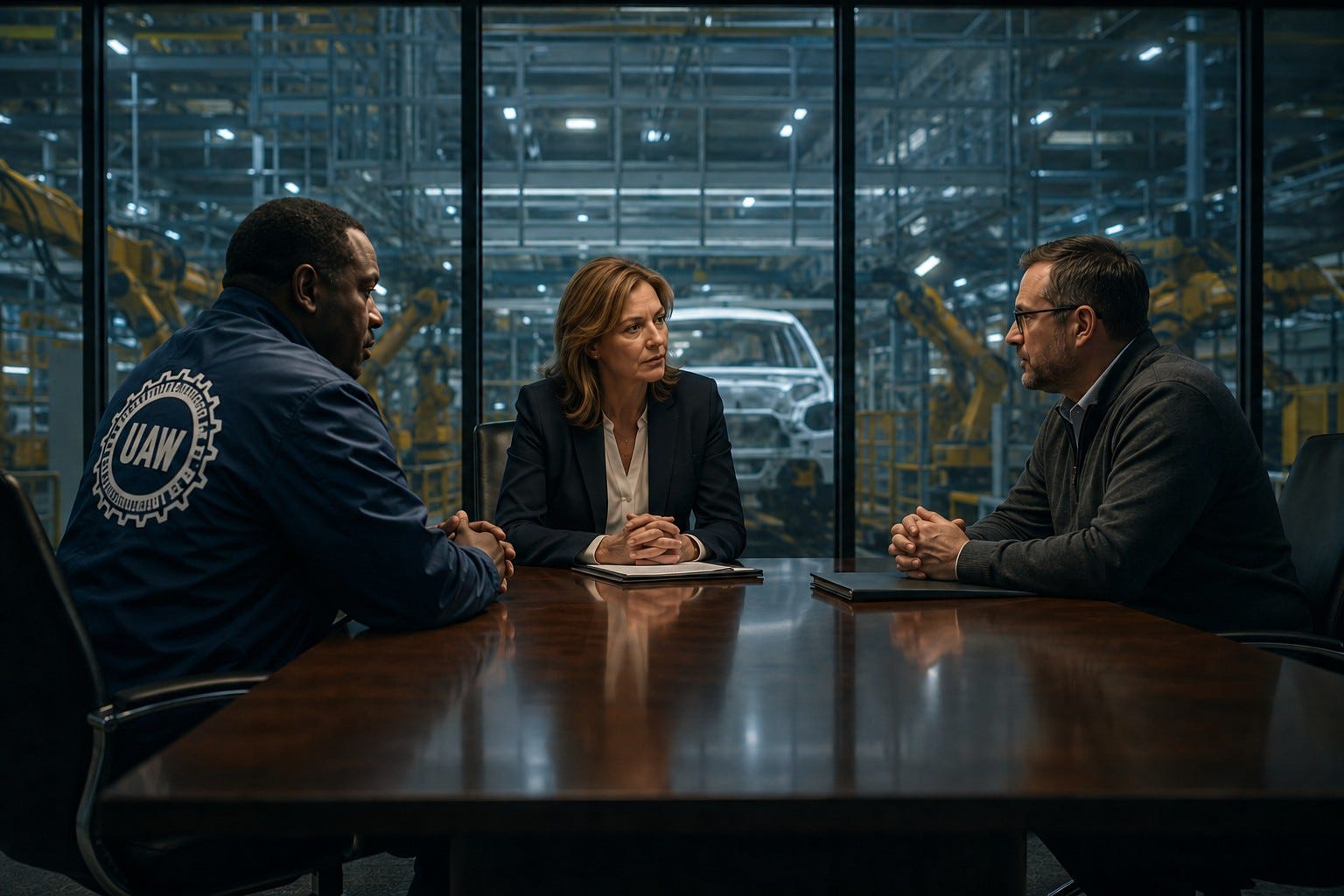
The United Auto Workers launched a strike on June 1st against a plant that produces axles for GM’s full-size trucks. Even though it is only a single facility with fewer than 1,000 workers, the outcome of the strike “game” will have profound implications for the UAW, GM, and the U.S. automotive industry.
Though the strike is against Dauch Corporation – known until recently as American Axle & Manufacturing – the UAW’s main leverage comes from the strike’s potential impact on OEMs, particularly GM.
Dauch has little direct incentive to settle quickly, since it is losing money, faces tough competition, and the union is asking for a 40% raise.
GM wants the strike to end quickly, since each day of lost full-size truck production at even a single plant reduces profit by at least $25M.
The UAW is hoping to increase wages at suppliers substantially for a variety of strategic reasons and would like to use an increase at Dauch to set a new baseline.
The unique history and leverage at Dauch may enable the UAW to demand more, last longer and push harder than at other suppliers, but could also cause it to overplay its hand.
Because this game will be repeated across the unionized supply base and over time, GM needs to be very strategic in its role and careful in its tactics.
The outcome of this strike will powerfully affect U.S. automotive industry bargaining through the next round of national negotiations with the Detroit 3 in 2028 and help determine its long-term competitiveness.
The History of the UAW-Dauch-GM Game
To understand this strike and its stakes, context and history are needed. The plant is owned by Dauch Corporation, formerly known as American Axle & Manufacturing. American Axle was created in 1994 when investors led by Richard Dauch bought facilities owned by GM’s Saginaw Division, an early move in the unwinding of the vertical integration of U.S. automakers. A major reason for the unwinding was that labor costs were much higher at the Detroit 3 than at independent suppliers, particularly those not represented by the UAW.
Labor relations were contentious at American Axle for many years, with the company threatening to move business to Mexico and the UAW pressuring GM to keep the business with American Axle and in the U.S. In 2008, the UAW went on strike for 87 days, one of the longest in the history of the automotive industry. The strike finally ended with wages being cut from $29 to $18.50 per hour. Critical to the settlement was a $200M payment by GM – more than $50K per worker and half the total cost – for early retirements, buyouts, and “buydowns”. In addition to feeling the direct effects of the strike, GM was successfully pressured by the UAW to get involved by “health and safety” strikes at two unaffected, profitable plants.
In the aftermath of the strike, American Axle has continued to shrink its original U.S. footprint, expanding operations in Mexico and its product line through acquisitions, renaming itself as Dauch Corporation earlier this year. The Three Rivers Michigan plant that is on strike is the last remaining of its original U.S. operations.
Shortly after the 2008 strike ended, the Great Recession hit and American Axle nearly went bankrupt. It became profitable as the industry recovered, but it is highly leveraged. The company has had negative net income in four of the last six years and expected to lose money this year even before the current strike.
The Stakes of the Game
All three of the main players – UAW, Dauch, and GM – have much at stake in the strike. Shawn Fain and the rest of the UAW leadership face elections next year amid significant dissent and dissatisfaction within their ranks. They want to demonstrate their aggressiveness and effectiveness. They also want to narrow the gap between supplier and Detroit 3 wages and benefits that widened enormously with the 2023 contracts. Other suppliers, starting with Nexteer, will be watching how the strike plays out and what the final terms are.
For Dauch, the strike risks being existential. The stock price, though up over the last year, is down almost 50% over the last 5 years and investors were already questioning Dauch’s competitiveness and debt load. Facing losses and integrating recent acquisitions, an enormous wage increase or potential loss of GM’s business would be devastating. There are also likely to be emotions involved. The plant’s current competitiveness was bitterly won and the leadership has also had to manage through years of swings (some caused by the UAW) in the volume and direction of GM, its major customer. Even the company’s new name may have an impact, since it is shared by the CEO and his late father, the company founder. David Dauch will not want to have his company beholden to the UAW.
The short-term risks for GM are clear. Switching to another plant or another supplier would be quite costly, risky, and time-consuming. Once axle inventories run out, production of affected trucks will stop. Losing one day of full-size truck production at Flint Assembly will reduce GM profits by at least $25M, due to the high demand for and profitability of the trucks. A strike that extends beyond GM’s annual two-week shutdown in July would be very painful. But just writing a check to pay for labor peace would be strategically costly, since workers at other suppliers would make similar or even greater demands and the UAW would be emboldened right through 2028 bargaining.
The Impact of Framing on the Strike
As with many negotiations, how each side frames its position will influence the outcome. To justify their demand for a 40% wage increase over the current $22/hour, the UAW refers back to the wages before 2008, which after inflation adjustment would be more than $45. They claim the “concessions” were made “to save the company” and intended to be temporary. This is not historically accurate. The 2008 wage cuts occurred before the recession and after a bitter strike and were accompanied by buyouts/early retirements/ buydowns that show permanent intent; they were designed to achieve a competitive cost structure. However, the framing may have more impact than just PR value. It may reinforce worker willingness to withstand a long walkout and make it difficult to ratify any contract with a more moderate increase.
Framing also matters for Dauch. If it views the strike and UAW demands as final indications that the UAW cannot be worked with, it may decide to close the plant and move the business elsewhere or give it up. Moving to Mexico would be impossible in the short term given the ongoing USMCA negotiations and the certain angry reaction of the Trump Administration, but the UAW should be concerned about GM finding another source of supply.
Framing will likely determine GM’s actions as well. If the Dauch strike is viewed as a one-off event or if GM focuses on the short-term pain, GM will push Dauch to settle and perhaps (quietly) financially facilitate it. If it is seen to be a battle that will determine supplier wage levels, GM may scramble to keep full-size truck production going and prepare for a lengthy strike.
The Likely Battle
Shawn Fain is likely to view the Dauch strike as an ideal battleground. The plant’s products create maximum leverage, particularly since GM is eager to gain highly profitable market share while Ford deals with aluminum supply issues. Dauch workers’ wages have not kept up with inflation, even after the 2008 reset. The Trump Administration’s looming presence makes a threat to move production to Mexico not very credible. Since fewer than 1000 workers are affected, there is modest material impact on the UAW strike fund. A lengthy strike would signal strength to both members and the entire industry. A big win would resound in other negotiations and enhance his election prospects. As long as the workers are willing to bear the pain of the strike, Fain will feel in a comfortably strong position. However, there is a risk that the UAW will overplay its hand, either by killing the plant or setting expectations too high both for Dauch workers and UAW members at other suppliers.
Both GM and Dauch should realize that the final contract will have a sizable wage increase. They should avoid pointing the finger at each other and saying, “you pay for it”; when there was a three-way stalemate among the UAW, Delphi, and GM in 2005, the outcome was disastrous for all three players. Instead, both companies should be prepared for a lengthy walkout and Dauch should start pushing for a “fair” settlement with a sizable wage hike in a few weeks, after worker enthusiasm for the strike has started to wane. Whether GM needs to contribute financially to facilitate a settlement is something that the two companies can negotiate secretly.
Both the final wage number and how it is achieved will matter for the rest of the industry. They should be watching developments and tactics closely and preparing for battle. They may well be next.